
Recession files (part 19): did Ford cause the recession?

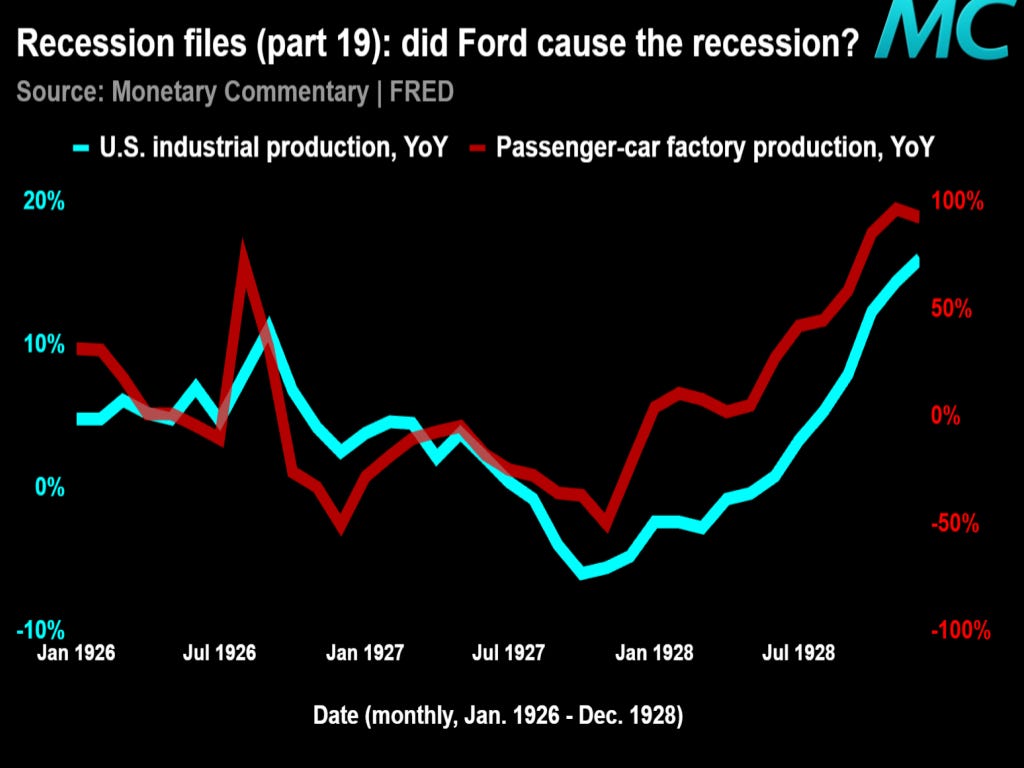
Could Henry Ford have caused a U.S. recession?
In 1927, the question was not ridiculous. Ford was among the largest industrial companies in the world, and the Model T sat at the center of a vast network of workers, steelmakers, parts suppliers, dealers and transport companies. Yet the car had become outdated as General Motors offered consumers more models, colors and annual upgrades. Ford finally produced its last Model T on May 26, then shut its plants for roughly six months to retool for the Model A.
The timing created a compelling story, although the chronology weakens it. The recession began in November 1926, six months before Ford stopped production. Total industrial output had already lost momentum, while Chevrolet and other manufacturers captured customers Ford temporarily surrendered. Recent research finds no clear structural break in aggregate activity when the shutdown occurred and concludes that the implied Ford shock was much larger than the recession itself.
Ford’s shutdown still mattered. It intensified weakness in one of America’s most economically connected industries and made a mild downturn easier to see. The recession ended in November 1927, just before the Model A’s December debut and the renewed expansion that carried the economy toward 1929.
What we learn from this recession is that a dominant company can magnify a business-cycle downturn, but even an industrial giant rarely creates an economy-wide recession by itself.