
Recession files (part 8): the Baring shock reaches America

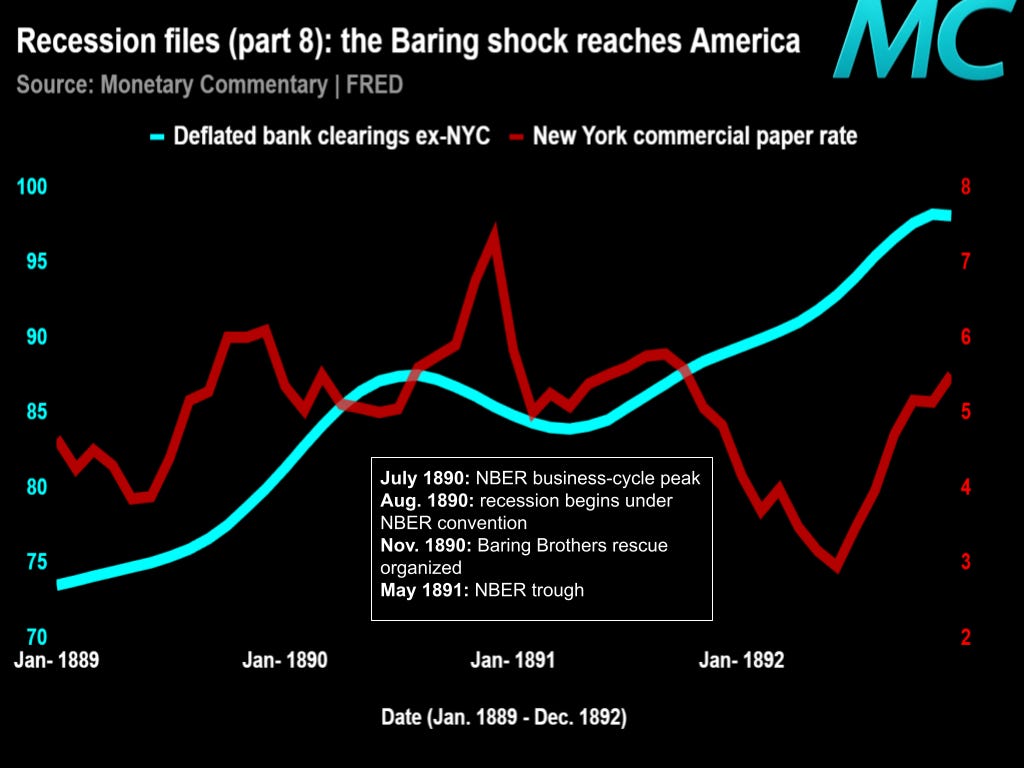
The interesting thing about the 1890-91 recession is that it was America’s downturn, but not only America’s story.
By 1890, the U.S. was already part of a financial world where stress could move through London, Argentina, New York credit markets, and domestic commerce without needing a modern banking system or floating exchange rates. Baring Brothers had become deeply exposed to Argentine finance, and when confidence cracked, the Bank of England helped organize a rescue to stop the failure from turning into a wider panic. The American recession dated by NBER had already begun around that same window, running from the July 1890 peak to the May 1891 trough. The chart should therefore be read as a payments-and-credit chart.
Deflated bank clearings outside New York City are the key line because they move the visual away from Wall Street alone and toward the commercial economy: checks, payments, trade, and settlement activity across the country. The commercial paper rate adds the financing side, showing the price of short-term business credit in New York. Together, they capture a 19th-century version of global financial contagion: the shock comes through capital confidence and funding markets, but the damage shows up in the flow of domestic transactions.
What we learn from this recession is that globalization did not begin with modern supply chains; by the 1890s, the U.S. business cycle was already exposed to foreign credit accidents through the plumbing of payments, trade finance, and short-term money markets.
This made me wonder whether crises rarely spread through the things we notice first.
The headlines are about banks, markets, sovereign debt, or interest rates.
But the lived experience shows up somewhere else.
A supplier waits longer to get paid.
A business delays hiring.
A family postpones a purchase.
Trust becomes a little more expensive.
It feels like the same pattern we keep seeing across very different systems.
The visible shock isn't always the system.
It's often the signal that relationships underneath the system have become strained.
Maybe recessions aren't just failures of finance.
Maybe they're moments when hidden interdependencies become impossible to ignore.