
Recession files (part 9): the Panic of 1893

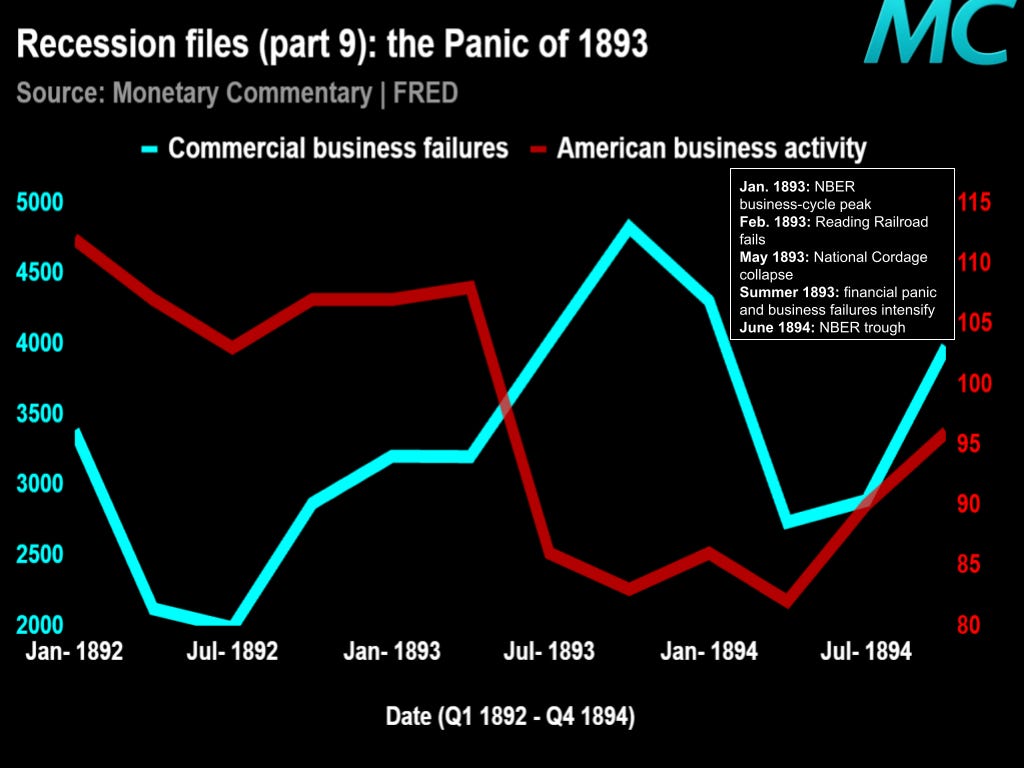
The Panic of 1893 is usually remembered as a financial panic, but the better chart is a body count.
Not people — firms. Commercial failures are what make this recession look different. The official downturn runs from the January 1893 peak to the June 1894 trough, but the violence of the episode shows up in the number of businesses that simply could not survive the combination of railroad overexpansion, tight credit, falling confidence, and gold-standard pressure. The failure of the Reading Railroad in February 1893 and the collapse of National Cordage in May 1893 were symbols of a system where leveraged expansion had reached the point where refinancing itself became the problem.
Business activity tells you the economy was contracting. Business failures tell you what contraction meant on the ground: merchants, manufacturers, brokers, and trading firms disappearing because credit could not carry them through. The chart turns the Panic of 1893 into a solvency recession, where the macro story is not just lower output, but the destruction of commercial balance sheets.
What we learn from this recession is that a credit crunch becomes historically dangerous when it stops being about market prices and starts becoming about which firms are still alive.